

If you’re from Missoula and you’ve been on Facebook lately, you may already know why I’m writing this.
A very public family dispute involving The Greek Pastry Shop, better known locally as #1 Gyros, started playing out through the restaurant’s Facebook presence.
Posts became intensely personal. Customers jumped into the comments. Screenshots circulated. People started trying to figure out who was posting, what was happening behind the scenes, and what any of it meant for the restaurant.
One of the longer and more inflammatory posts that initially drew attention has since been deleted.
But that doesn’t make the reputation-management lesson disappear. Over 1000 people reacted to the post, hundreds of comments, and nobody knows how many eyeballs actually saw the post, including me.
In fact, what happened before and after that deletion may be the most useful part of this entire story for other local businesses.
I’m not interested in determining which family member was right.
I’m a marketer, not a family therapist.
What interests me is a much more practical question:
How does a private conflict become official business communication in the first place?
Because that’s a vulnerability a shocking number of small businesses have right now.
The First Failure Happened Before Anything Was Posted
It’s easy to look at a social media disaster and say:
“Someone shouldn’t have posted that.”
True.
But that’s not the most useful lesson.
The better question is:
Why was someone in the middle of a personal conflict able to use a business asset to wage that conflict in the first place?
That’s an access and governance problem.
A company’s Facebook page isn’t fundamentally different from its website, Google Business Profile, domain registrar, company email or payment accounts.
These are business assets.
Yet small businesses routinely manage them like family Netflix accounts.
Someone created the Facebook page eight years ago.
An employee has the login.
The owner’s daughter helps with Instagram.
An old marketing company still has Google access.
Nobody remembers whose email address owns the domain.
Three people know the WordPress administrator password.
Everything works fine.
Until it doesn’t.
Then suddenly the business discovers that someone involved in a personal, employment or ownership dispute has the ability to speak publicly as the company.
That isn’t just a social media problem.
That’s a business continuity problem.
The Logo Changes Who Is Speaking
One of the posts still publicly visible on the #1 Gyros Facebook page makes this issue unusually easy to see.
The restaurant’s page shared a personal post from a family member and responded:
“Shame on you, for making your father your public project. It looks like I did an awful job with you, my son.”
The important part of that example, from a marketing perspective, isn’t who said what first.
It’s the name above the response:
The Greek Pastry Shop – #1 GYROS.
That’s what customers see.
Facebook may know which administrator physically pressed Publish.
Customers don’t.
To them, the business said it.
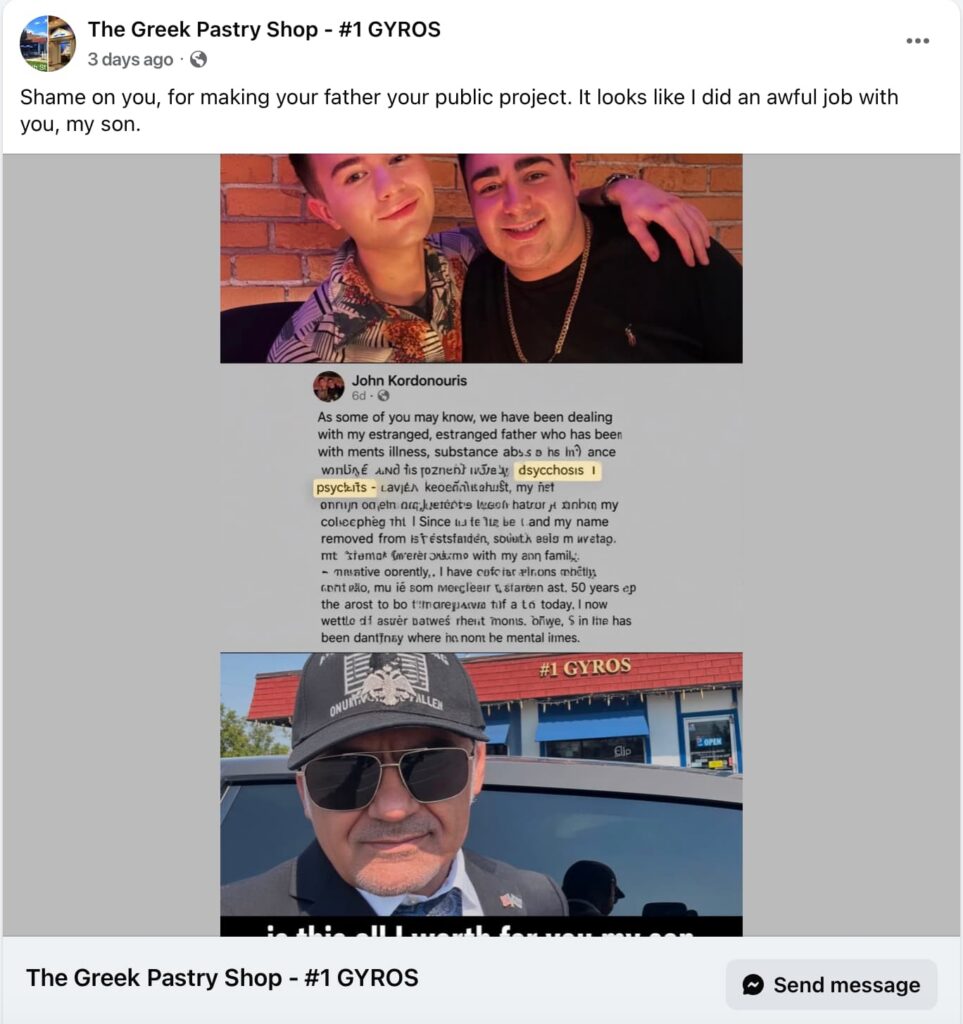
Screenshot of a public post from The Greek Pastry Shop – #1 Gyros Facebook page, captured August 26, 2026. Personal allegations contained within the shared post have been obscured because they are not relevant to this analysis.
This distinction matters far beyond this particular restaurant.
If Susan posts an opinion from Susan’s personal Facebook account, Susan said it.
If Susan publishes the exact same statement through ABC Plumbing’s Facebook page, ABC Plumbing said it.
Your logo changes the speaker.
That’s why giving someone publishing access to a business account isn’t simply giving them permission to “help with Facebook.”
You’re giving them the ability to speak using the company’s identity.
If Someone Can Destroy Your Reputation During an Argument, They Have Too Much Access
Here’s a question I wish more business owners would ask:
If one employee, family member, former partner or marketing company became furious with me tonight, what could they do to my business online?
Could they publish on Facebook?
Delete posts?
Answer customers?
Change your Google Business Profile?
Respond to reviews as your company?
Change your website?
Access customer information?
Change your business hours?
Redirect your domain?
Delete your YouTube videos?
Lock you out of an account entirely?
If you don’t know the answer, that’s already a problem.
Businesses spend thousands of dollars on locks, cameras, insurance and alarm systems while sometimes giving nearly unrestricted control of their digital identity to people who no longer even work there.
We protect the keys to the building better than we protect the keys to the business.
Access Is Only the First Layer
There’s another important distinction.
Proper digital governance has at least three layers:
Access: Who technically can publish or make changes?
Authority: Who is actually authorized to do so?
Policy: What are they allowed to publish or change while representing the business?
Those aren’t the same thing.
You can have excellent password security and still have a reputation disaster if nobody has established what is appropriate to publish through company channels.
Imagine five people have legitimate access to your Facebook page.
One starts sharing political opinions.
Another shares personal religious content.
Another gets angry with a negative reviewer.
Another thinks an edgy meme is hilarious.
The owner thinks:
“Well, that was Sarah posting.”
Your customers don’t necessarily know Sarah exists.
They see your logo.
That doesn’t mean businesses have to be sterile.
#1 Gyros, for example, appears to have shared Greek Orthodox and religious material well before the current dispute. That can simply be part of the identity of a longstanding Greek family business.
The issue isn’t whether a business posts something unusual, religious, political or personal.
The important question is whether that communication is intentional business communication or simply whatever an administrator felt like sharing that day.
“They’re Family” Is Not an Access-Control Policy
Family businesses are especially vulnerable to this.
Trust and authorization aren’t the same thing.
You can completely trust your spouse, child, sibling or business partner and still structure access properly.
In fact, you should.
People leave businesses.
Relationships change.
Employees get fired.
Partnerships dissolve.
People get sick.
People die.
Phones get stolen.
Accounts get hacked.
And sometimes perfectly reasonable people have extremely unreasonable days.
Good account management isn’t an accusation that somebody is untrustworthy.
It’s what prevents a personal emergency from automatically becoming a business emergency.
There should be a clear primary owner of every critical digital asset and a documented reason for everyone else’s access.
Not:
“I think John set that up.”
Not:
“Sarah knows the Facebook password.”
Not:
“Our old SEO guy probably owns the Google listing.”
Those sentences should scare business owners far more than they usually do.
But What If the Owner Is the Problem?
This is where access control alone isn’t enough.
Most digital-security advice assumes we’re protecting a business from a rogue employee, disgruntled contractor or former partner.
But sometimes the person making the questionable decision has completely legitimate authority.
Maybe it’s the owner.
Maybe it’s a family member who owns half the company.
Maybe it’s the person who originally created the Facebook page.
You can’t solve that with a stronger password.
That’s why mature businesses need communication governance, not merely account security.
A very simple policy might be:
During an active legal, family, personnel or customer dispute, nobody directly involved publishes about the dispute through company channels without another authorized person reviewing it first.
That might sound overly formal for a five-person local business.
It won’t sound overly formal the day you need it.
Policies like that aren’t bureaucracy. They’re seatbelts.
You usually don’t appreciate them until something goes wrong.
Deleting the Post Doesn’t Delete What Happened
The longer #1 Gyros post that initially drew significant attention appears to have subsequently been removed.
Removing inflammatory content can absolutely be part of containing a reputation problem.
But here’s the uncomfortable part:
The internet has an undo button for publishing. It doesn’t have an undo button for being seen.
By the time a post gets deleted, people may already have:
Taken screenshots.
Shared it privately.
Discussed it in local groups.
Searched Google for the people involved.
Commented publicly.
Sent it to friends.
Posted about it elsewhere.
The delete button removes something from one location.
It does not remove the experience from the people who already saw it.
And in this case, other posts relating to the family dispute remained publicly visible after the larger post disappeared.
That’s why deleting the worst post isn’t the same thing as containing the crisis.
You’ve removed one symptom. You haven’t necessarily fixed the vulnerability that produced it.
Reputation Management Has Three Stages
This is where businesses often misunderstand reputation management.
It’s not one action.
It’s at least three.
Prevention
Before anything happens:
Know who owns every digital asset.
Know who has access.
Use individual accounts instead of shared passwords wherever possible.
Give people only the permissions they actually need.
Remove access when employees, contractors or agencies leave.
Establish who is authorized to speak for the business.
Decide what requires approval before publication.
Containment
Once something goes wrong:
Stop unnecessary publishing.
Determine who currently has access.
Secure the accounts.
Document what was published.
Review posts, comments, scheduled content and replies across platforms.
Determine whether other business assets are affected.
Designate one person to handle public communication.
Remove inappropriate business communications when appropriate.
And most importantly:
Stop creating new material for the internet to distribute.
Recovery
Then restore normal business communication.
Make sure your website is accurate.
Make sure your Google Business Profile is accurate.
Answer the operational questions customers actually have.
Are you open?
Are the hours normal?
Can customers still place orders?
Has ownership changed?
Who should customers contact?
Then start behaving like a business again.
For a restaurant, that means something wonderfully boring.
Show the food.
Show the kitchen.
Post the hours.
Thank customers.
Introduce staff.
Tell people about tomorrow’s special.
Reputation recovery is partly the process of restoring the association between your name and the thing you’re actually in business to do.
Going Viral Isn’t Always Marketing
There’s another trap in situations like this.
Engagement can explode.
Comments.
Shares.
Screenshots.
Profile visits.
People talking about the business all over town.
Someone looking only at social-media metrics could say:
“Holy crap. Look at the engagement.”
But attention isn’t automatically valuable.
If thousands of people suddenly visit your restaurant’s Facebook page because they want the next episode of a family fight, you haven’t necessarily built an audience for your restaurant.
You’ve built an audience for the spectacle.
There’s an enormous difference.
Going viral isn’t always marketing.
Sometimes you’ve simply turned your business into entertainment.
The question isn’t:
How many people are talking about us?
It’s:
What are they now associating our name with?
That’s brand management.
Social Media Problems Become Search Problems
This is where reputation management overlaps directly with SEO.
Something happens on Facebook.
Then what?
People Google it.
Someone who normally searches:
#1 Gyros Missoula hours
may suddenly start searching for the business alongside terms related to the owner, Facebook, closing, controversy or whatever else they’ve heard.
They’re trying to understand what’s happening.
Google then assembles an answer from whatever exists online.
Your website.
Your Google Business Profile.
Facebook.
Reddit.
Reviews.
Videos.
Local news.
Other websites discussing you.
At that point, your reputation isn’t simply what you published.
Your reputation is what someone finds while trying to figure out what happened.
That’s why SEO and reputation management can’t really be separated anymore.
When Customers Are Confused, Your Job Is to Become Boring
During a public controversy, businesses often think they have two options:
Say nothing.
Or defend themselves.
There’s a third.
Communicate without litigating the dispute in public.
If I were advising a business in this situation, I wouldn’t begin by asking who was right.
I’d ask:
What does the customer need to know?
Is the restaurant open?
Are the hours normal?
Can I still order?
Is ownership changing?
Is customer information safe?
Who currently speaks for the company?
Those are business questions.
Answer those.
Leave everything else somewhere other than the company Facebook page.
Something as simple as:
“We’re currently dealing with a private internal matter. Our restaurant remains open and serving the Missoula community. We appreciate your patience, kindness and support while our family works through this privately.”
Then stop.
Because crisis communication isn’t supposed to satisfy the emotional needs of the people fighting.
It’s supposed to reduce uncertainty for everyone else.
Your Website Should Be the Boring Source of Truth
Social platforms are useful, but businesses don’t control Facebook.
They don’t control Reddit.
They don’t control Google.
They do control their website.
During a reputation event, the company’s owned digital properties should become painfully reliable.
Hours are correct.
Phone numbers work.
Operational updates are easy to find.
The Google Business Profile matches the website.
Important announcements are consistent.
Customers shouldn’t have to interpret cryptic posts or dig through comments to determine whether you’re open for lunch.
Your website doesn’t have to win the argument.
It needs to answer the customer’s question.
Your Agency Shouldn’t Own Your Business Either
This lesson applies to marketing companies too.
I run one.
Your agency shouldn’t hold your digital business hostage.
You should own your domain.
You should retain appropriate ownership of your Google Business Profile.
You should know where your website is hosted.
You should know which accounts exist.
Your agency may need administrative access to do its job, but there’s an enormous difference between managing an asset and owning an asset.
If firing your marketing company means losing your domain, website or Google listing, something was structured incorrectly from the beginning.
Good digital infrastructure assumes relationships can change.
That applies to agencies.
Employees.
Partners.
And family.
Do a Digital Key Audit Before You Need One
If you’re a local business owner reading this, here’s the exercise I’d actually recommend.
Make a list of your digital keys:
Facebook
Instagram
Google Business Profile
Website
WordPress
Domain registrar
DNS
Website hosting
Google Analytics
Google Search Console
Google Ads
Email marketing platform
YouTube
Business email
Cloud storage
Payment systems
Then answer four questions for every one:
Who owns it?
Who currently has access?
What level of access do they have?
Could I remove that access today if I needed to?
Then add a fifth:
Who is authorized to speak publicly as my company?
If you can’t confidently answer all five, you’ve found a vulnerability.
Not necessarily a crisis.
A vulnerability.
And that’s exactly when you want to find it.
The Biggest Lesson Isn’t “Don’t Fight With Your Family on Facebook”
Everyone already knows that.
The bigger lesson is uncomfortable because it applies to far more businesses:
Your company needs systems that protect its public identity even when the humans behind the company are having their worst day.
The reputation problem at #1 Gyros didn’t begin because somebody chose the wrong SEO keyword.
It didn’t begin because the restaurant needed more reviews.
It didn’t begin because a Facebook ad performed badly.
A human conflict occurred.
The business’s digital presence became an amplifier.
That’s what good reputation infrastructure is supposed to prevent.
You can’t guarantee that employees, owners, family members, customers or partners will always behave perfectly.
They’re human.
But you can build a business where one person’s worst afternoon doesn’t automatically become the company’s public identity.
And if you’re not sure whether your business is built that way, don’t wait for a Facebook post to find out.